Patellofemoral Pain (Pain Around the Kneecap): Causes, Exercises and Recovery

Patellofemoral pain (pain around the kneecap): causes, exercises, and recovery
Do you experience pain around or behind your kneecap when climbing stairs, squatting, running, or after sitting with your knees bent for a long time? This could be patellofemoral pain (PFP), also known as patellofemoral pain syndrome (PFPS). It is one of the most common knee complaints among athletes, but you don't have to be an athlete to develop it. In this blog, you will learn what patellofemoral pain is, how to recognize it, what you can do yourself, which exercises help, how long recovery takes, and when it is wise to see a physical therapist.
What is patellofemoral pain?
Your kneecap (patella) is located at the front of your knee. When you bend and straighten your knee, the kneecap glides through a groove in your thigh bone (femur). The joint between the kneecap and the thigh bone is called the patellofemoral joint. With patellofemoral pain, this area becomes painful and sensitive, usually because the load has become greater than the joint can handle at that moment. The pain is located around, behind, or below the kneecap and is often difficult to pinpoint with a single finger.
Patellofemoral pain occurs in men and women of all ages and at all activity levels. It is most commonly seen in teenagers and young adults and is more frequent in women. It feels unpleasant, but in most cases, nothing is damaged: it is an overloaded, sensitive joint that you can make resilient again with the right approach.
Causes and risk factors
Patellofemoral pain rarely has a single cause. Usually, several factors play a role at the same time. The most important is an increase in load that is too rapid: running, cycling, squatting, or jumping more quickly than your knee is accustomed to. Sports where your knee is under load while bent, such as running, cycling, volleyball, basketball, and strength training with squats and lunges, therefore often cause symptoms. Sitting for long periods with bent knees, for example while studying, working, or driving, can also trigger or worsen the symptoms.
In addition, less strength or control in the hip, glutes, and thigh can play a role, as well as the way you move when landing or climbing stairs and the position of your feet. A period following trauma or surgery, during which your knee was loaded differently, can also be a factor. Researchers therefore view patellofemoral pain as a condition with multiple causes, not just a problem with the kneecap itself.
Symptoms: how do you recognize patellofemoral pain?
A characteristic symptom is pain at the front of the knee, around or behind the kneecap, during activities where your knee is bent and under load. Think of climbing stairs (especially going down), squatting, standing up from a chair, running, cycling, and jumping. Many people also notice symptoms after sitting for a long time with bent knees, for example in a lecture hall or at the cinema. Sometimes you hear or feel clicking in the knee, or the knee feels stiff or slightly swollen. The pain can vary significantly: one day it goes fine, the next day it is painful. A knee that truly locks, gives way, or consistently buckles is not typical of patellofemoral pain and should be evaluated by a professional.
When should you see a doctor or physical therapist?
Not every pain around the knee is patellofemoral pain. A tendon issue, a meniscus injury, a runner's knee (pain on the outside) or in children and teenagers Osgood-Schlatter can cause pain in or around the knee. If you want to know exactly what you have, you can go directly to a physical therapist in the Netherlands. Be sure to make an appointment if your knee becomes swollen or remains swollen, if your knee locks, catches, or gives way, or if you also have pain at rest or at night. The same applies if the symptoms started after a fall or twisting movement, if there is redness, warmth, or fever, or if the symptoms do not improve after a few weeks, despite adjusting your activity level.
What can you do yourself for patellofemoral pain?
The goal is for the pain to decrease while you remain as active as possible. Complete rest is usually not necessary, and the symptoms do not always disappear on their own. The most important thing is to adjust your activity level and start exercising.
Adjust your activity level. Temporarily reduce what triggers the pain: fewer kilometers and hills, fewer deep squats and lunges, less stair climbing, and avoid sitting with bent knees for too long at a time. Stand up occasionally or stretch your legs. A rule of thumb is that the pain during an activity should not be higher than 3 or 4 on a scale of 10 and should not be worse the next morning.
Stay active in a way that suits you. Swimming, rowing on a rowing machine, walking on flat terrain, or strength training without painful deep knee bends is often possible. Cycling can cause symptoms for some people, for example with a low saddle or a heavy gear, so test it carefully and have your saddle height checked if necessary.
Start with exercises. This is the most important part of the approach (see below). Exercises only help if you do them regularly and with good technique, and you usually only notice the effect after a few weeks.
Tape and insoles can provide support. Tape, for example according to McConnell, can reduce pain in the short term so that you can exercise more easily. Sometimes a pre-formed insole is recommended for a clearly collapsed arch. Both are a supplement to exercise therapy and work mainly in the short term; they are not the solution in themselves. A knee brace or bandage is usually not necessary.
Exercises for patellofemoral pain
Start with exercises that you can do pain-free and build them up as the pain decreases. First sitting or lying down, then standing, and finally in postures and movements that resemble what you do daily or in your sport. Focus on the glutes, hips, and thighs. Do the exercises about three times a week. They may feel tiring, but the pain in your knee should not increase more than slightly. The numbers below are a general guideline, and your physical therapist will adjust them for you.
Bridge (glute muscles). Lie on your back with your knees bent and your feet flat on the floor. Lift your pelvis until your body forms a straight line from your shoulders to your knees, hold for two to three seconds, and lower yourself back down slowly. Perform three sets of ten to fifteen repetitions.
Side-lying leg lift (hip). Lie on your side with your bottom leg bent and your top leg straight. Lift your top leg in a controlled manner and lower it slowly, ensuring your pelvis does not tilt backward. Perform three sets of twelve to fifteen repetitions per side.
Lateral band walk (hip and glute). Place a resistance band around your thighs, just above your knees, and stand with your knees slightly bent. Take ten steps to the left and ten steps to the right, and repeat this three times. Make sure your knees do not cave inward.
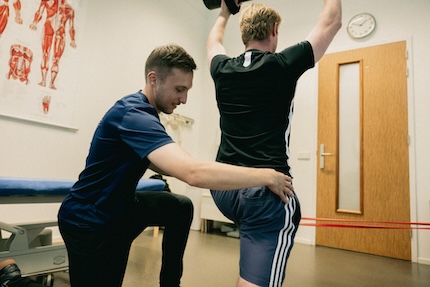
Step-down (thigh and hip, standing). Stand on a low step and slowly lower yourself until your other heel touches the floor, ensuring your knee does not cave inward. Then, push yourself back up. Start with a low step and perform three sets of eight to ten repetitions per leg. If this is not yet pain-free, start by standing up from a high chair.
How does physiotherapy help with patellofemoral pain?
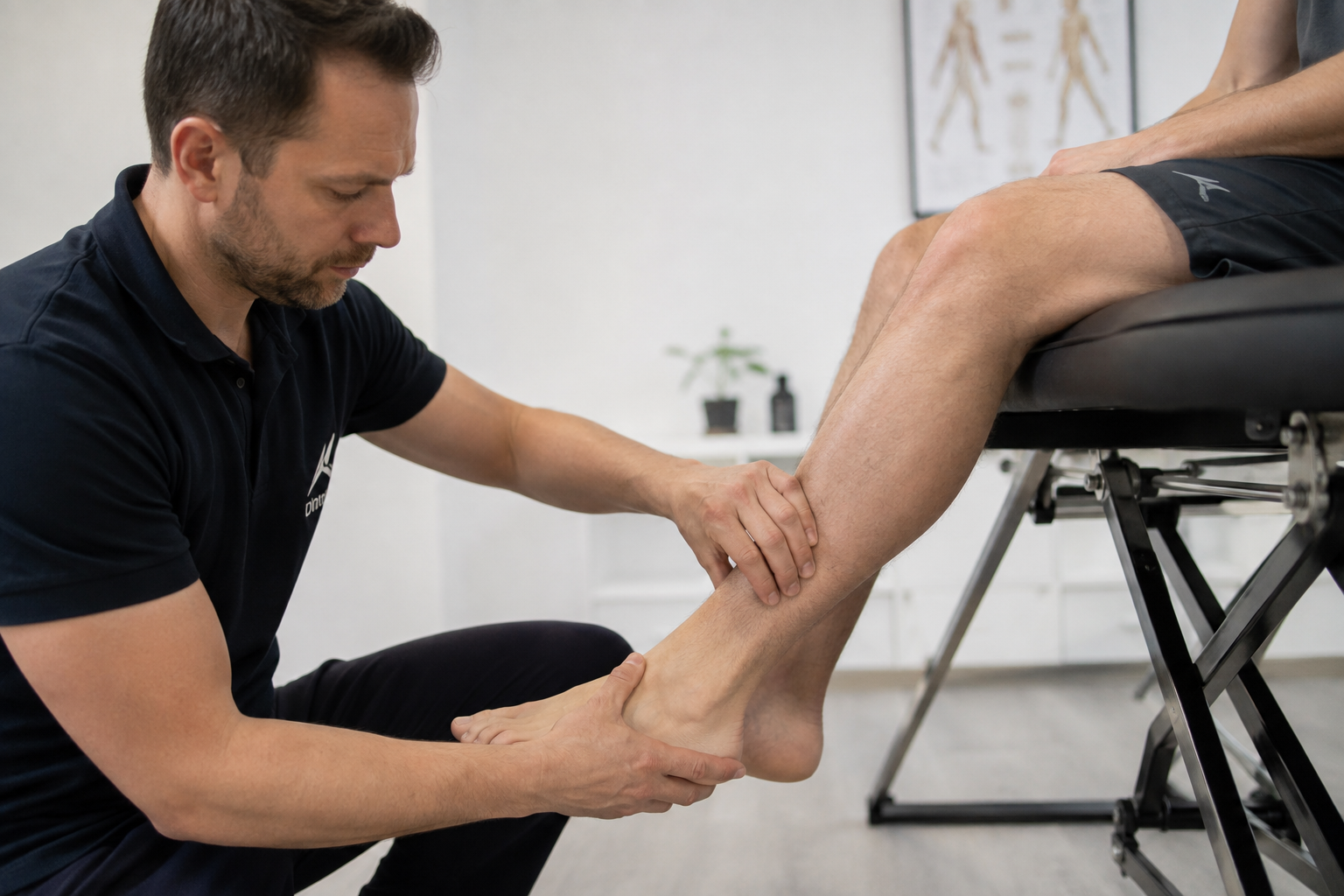
At USC Physiotherapy in Amsterdam East, we start with an accurate diagnosis, as pain at the front of the knee does not always have the same cause. We then create an exercise program tailored to your specific complaint and sport, which we build up step-by-step in our fitness and exercise rooms. This takes you from pain-free basic exercises to strength training and sport-specific movements.
If you are a runner, we use the Runeasi gait analysis to examine your running technique and see if minor adjustments can reduce the load on your knee. Where appropriate, we provide advice on taping or insoles as a supplement. At the end of the program, we objectively test whether you are ready to return to sports.
How long does recovery take?
That varies from person to person. With recent symptoms, you will often notice improvement within a few weeks if you adjust your activity levels and exercise regularly, but full recovery can take several months. For long-standing issues, it may take longer. Patellofemoral pain can also recur, especially if you stop exercising or return to your previous intensity too quickly. Consistency is therefore more important than speed.
When can you return to sports?
You can start building back up to your sport once you are pain-free in daily life, can walk up and down stairs without pain, can perform a step-down or squat pain-free without your knee caving inward, and have sufficient strength in your hip and thigh. Build up gradually from there. For running, use a walk-run schedule, as described in our blog Running schedule after an injury. For cycling, start with short rides and a light gear, and for strength training, start with shallower squats and lighter weights.
How can you prevent patellofemoral pain?
You can reduce the risk of patellofemoral pain by gradually building up your training and avoiding sudden changes in distance, pace, weight, or frequency. Strengthen your hip, glute, and thigh muscles at least twice a week and vary your activities—don't just run or cycle. If you sit for long periods, make sure to stand up or stretch your legs regularly. Adjust your training at the first sign of pain.
Frequently asked questions
Can I keep exercising with patellofemoral pain?
Often yes, in a modified form. As long as the pain stays within your pain threshold and isn't worse the next day, you can usually continue. Temporarily avoid activities that clearly trigger the pain.
Is knee clicking serious?
Clicking or popping without pain or swelling is usually harmless. If you experience pain, swelling, or a locking sensation, have it evaluated.
Does taping help with patellofemoral pain?
Tape can reduce pain in the short term, making it easier to exercise. It is a supplement to exercise therapy, not a solution on its own.
Do I need orthotics?
Not always. For severely flat feet, orthotics can help in the short term when combined with exercises. Your physical therapist will determine if they are useful for you.
Is patellofemoral pain the same as runner's knee?
No. The two terms are often mixed up, but they are two different injuries. The medical names are IT band syndrome and patellofemoral pain. Both are often called "runner's knee", although in English the term most often refers to patellofemoral pain.
Why do I have pain after sitting for a long time?
When sitting for long periods with bent knees, pressure remains on the joint between the kneecap and the thigh bone. If the joint is sensitive, this causes pain and stiffness. Standing up or stretching your legs regularly helps, and exercises will improve your knee's load-bearing capacity.
Do you have pain around your kneecap when climbing stairs, exercising, or sitting for long periods, and want to know what you can do about it? Don't wait too long and book an appointment at USC Physiotherapy. With locations at Science Park, Amstelcampus, and Roeterseiland in Amsterdam East, we are easily accessible. Together, we will ensure you can move and exercise with confidence again.
Sources: Patellofemoral Pain: Clinical Practice Guidelines (JOSPT, 2019) and 2018 Consensus statement on exercise therapy and physical interventions to treat patellofemoral pain (PubMed)