Running after an injury
Running after an injury
An injury doesn't automatically mean you have to sit still. It does, however, mean you need to build up differently than someone who isn't injured. A standard running plan or advice from your sports watch doesn't account for tissue that still needs to heal, and that is exactly what matters when you're injured. Sports physiotherapist Joep Kamphuis from USC Fysiotherapie explains how to return safely: step by step, based on criteria rather than weeks.
Why a standard running plan doesn't work after an injury
Joep runs about 50 kilometers a week himself and lets his sports watch determine his daily training stimulus. That works fine for him because he isn't injured. When you have an injury, it actually works against you.
"Most running plans and algorithms in sports watches are based on the exercise physiology of people without injuries. If you have an injury and follow a standard plan, those two things clash."— Joep Kamphuis, USC Fysiotherapie
The biggest mistake is that the progression is determined by your cardiovascular recovery time, whereas with an injury, the recovery time of your tendons, muscles, connective tissue, or joints is the deciding factor. These tissues heal more slowly and often require a lighter training stimulus. A common mistake: taking a week off and then "just testing what you can do." That almost always leads to disappointment and a longer recovery time.
Criteria instead of weeks: how phased progression works
Everyone wants to hear: "if you do this, you'll be running this far again in six weeks." But that doesn't work when you're injured. That's why we at USC use a phased running plan that isn't time-bound. You only move on to the next workout if you felt little to no pain during and after the previous one. If that's not the case, you repeat the workout. This way, you set the pace yourself and stay in control of your recovery.
The plan consists of three phases:
- Phase 1 – getting used to the impact. Short bursts of running, alternated with walking, on a soft surface. You count your steps instead of minutes.
- Phase 2 – building up intervals. The running segments get longer and the walking breaks shorter, until you can run for a significant number of minutes at a time.
- Phase 3 – continuous running. You build up to an hour of running on paved surfaces, with fewer and fewer walking breaks.
"So, pull the reins in on time."— Joep Kamphuis
An example: phase 1
This is what the start of phase 1 looks like. You run on a soft surface (grass, forest floor, or treadmill), start every workout with a 5-minute walk, and count the steps of one leg, for example, only your right leg.
- Workout 1: 10 sets of 40 running steps, with 30 walking steps in between
- Workout 2: 10 sets of 50 running steps, with 30 walking steps in between
- Workout 3: 10 sets of 60 running steps, with 30 walking steps in between
- Workout 4: 10 sets of 70 running steps, with 30 walking steps in between
- Workout 5: 10 sets of 80 running steps, with 30 walking steps in between
This is intentionally just an example. Which exercises, which surface, and what pace are right for you depends on your injury. That is why at USC you receive a full, customized schedule, along with a tailored exercise program.
The basic rules: pain and rest days
After every workout, note how it went. We ask you to rate three things on a scale of 0 to 10, where 0 is perfect and 10 is the worst:
- How much pain did you have while running?
- How much pain did you have afterwards, and how long did it last?
- Are there any specifics, such as feeling stiff the next morning?
If you notice little or no pain, move on to the next workout. If you notice more pain, repeat the workout. You will discuss what an acceptable score is for you with your physical therapist. In addition:
- On a soft surface (grass, forest floor, treadmill), take a minimum of 1 and a maximum of 3 rest days between workouts.
- On hard surfaces (asphalt, paving stones, concrete) take at least 2 and at most 3 rest days.
Just started running? Here is how to build up gradually
The same logic applies to beginners: your body needs to get used to the repetitive impact. Many starters are too enthusiastic and end up with an injury after just a few weeks. Joep's tip for everyone just starting out:
"Listen to your body. Run at an easy pace and do plenty of interval training with walking breaks in between. Avoid repetitive impact in the beginning and make sure you have the right running shoes."— Joep Kamphuis
An example of a gradual build-up for a beginner with no complaints, three times a week with at least one rest day in between. Start every workout with a 5-minute walk:
- Week 1: 8 times 1 minute running, 2 minutes walking
- Week 2: 6 times 2 minutes running, 2 minutes walking
- Week 3: 5 times 3 minutes running, 2 minutes walking
- Week 4: 4 times 5 minutes running, 2 minutes walking
- Week 5: 3 times 8 minutes running, 2 minutes walking
- Week 6: 2 times 12 minutes running, 2 minutes walking
- After that: build up to 25 to 30 minutes of continuous running
If a week feels too intense or you experience pain, feel free to repeat that week. A beginner's schedule is not a race. Keep your pace slow enough to hold a conversation, and make sure your rest days are truly days of rest.
Strength training: protection against overuse
Running alone is often not enough to prepare your body for the impact. With every step, your muscles and tendons absorb a multiple of your body weight. If they aren't strong enough, the risk of overuse increases. Research shows that strength training can significantly reduce the risk of overuse injuries. It is therefore not just a part of your recovery, but also one of the best ways to prevent new injuries.
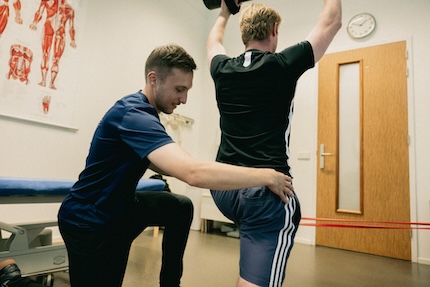
Not everyone has the same weak spots. Some lack strength in their calves, others in their glutes or hips, and for some, it comes down to core stability. Generic strength exercises found online often miss the mark. That is why at USC, we use tests to identify where you lack strength and create a tailored exercise program for you. You will receive exercises that suit your body, your injury, and your goals, to be done alongside your running progression. This way, you build not only your running volume but also the strength to sustain it.
When should you see a physiotherapist?
Make an appointment if:
- your pain does not decrease during or after running, or if it actually gets worse
- your symptoms keep returning as soon as you increase your training
- you are unsure how to safely build up your training again after an injury
- you suspect your running technique is contributing to your symptoms
Also read our articles on runner's knee and patellofemoral pain, two common injuries among runners.
Help with your running progression at USC
At USC Physiotherapy, all our colleagues work with these phased schedules. You will receive your personal schedule and a customized exercise program, including tailored strength exercises, via our exercise app, and we can also provide brief advice remotely. This way, you stay in control of your recovery and keep enjoying your runs.
View our page on sports physiotherapy or book an appointment now.