Sprained ankle: what to do and how long does recovery take?
Sprained ankle: What to do and how long is the recovery?
A sprained ankle often happens in a split second—a momentary lapse in concentration, an uneven patch of pavement, or an awkward landing after a jump is all it takes. It is one of the most common injuries, affecting both athletes and people who simply rolled their ankle while out for a walk. In this blog post, you will learn exactly what happens when you sprain your ankle, what you can do yourself, how long recovery usually takes, and when it is wise to see a physical therapist.
What exactly is a sprained ankle?
In a typical ankle sprain, the foot suddenly tilts inward (inversion), causing the sole of the foot to turn inward. This stretches the ligaments on the outside of the ankle, which can lead to damage. Spraining the ankle outward is much less common. The severity ranges from a mild ligament strain to a partial or complete tear. This explains why symptoms can vary so much from person to person: from mild swelling that disappears after a few days to an ankle that feels unstable for weeks.
Causes and risk factors
A sprained ankle usually occurs because you slip or misstep on an uneven surface, or land awkwardly after a jump, for example, while playing basketball, volleyball, or running. A direct push or contact during ball sports can also force the foot to tilt. Additionally, poor balance and neuromuscular control play a role, as do sports that involve frequent jumping, pivoting, and sudden changes of direction. Have you sprained your ankle before? If so, the risk of recurrence is higher, as ankle stability often remains compromised after a previous injury.
Symptoms of a sprained ankle
The severity of a sprained ankle can vary greatly, but certain symptoms are almost always present: pain on the outside of the ankle immediately after the sprain, swelling that often becomes visible within a few hours, and sometimes bruising due to subcutaneous bleeding. Difficulty bearing weight on the foot or walking is also common, as is a feeling of instability in the ankle, as if it might "give way." The more severe these symptoms, the greater the likelihood of more than just a mild strain.
What to do with a sprained ankle? The PEACE & LOVE principle
The well-known advice to ice a sprained ankle (the "RICE" protocol) is now being questioned. While icing may provide temporary pain relief, there is no convincing evidence that ice actually accelerates the recovery of an ankle sprain. Physical therapists are therefore increasingly using the PEACE & LOVE principle: two consecutive phases that clearly outline the best approach for each period. This principle was introduced in 2019 by researchers Dubois and Esculier in the British Journal of Sports Medicine and has since been widely adopted in physical therapy: https://pubmed.ncbi.nlm.nih.gov/31377722/
PEACE stands for the first few days after the injury, when the ankle is still acutely inflamed and sensitive.
Protection means protecting the ankle from movements that clearly aggravate your symptoms. This doesn't mean you should sit still: complete rest often slows down recovery rather than helping it. The goal is to manage your activity wisely during the first few days, for example by temporarily putting less weight on the ankle or using a cane or crutch if walking is painful, and trying to return to normal movement as soon as possible within your pain limits.
Elevation means keeping your ankle higher than your heart whenever possible. By using gravity to your advantage, excess fluid caused by swelling can drain away more easily. You will notice this, for example, because your ankle feels less tight and swollen after you have been sitting or lying down with your leg elevated for a while.
Avoid anti-inflammatories means being cautious with anti-inflammatory treatments, whether in the form of ice or medication like ibuprofen. The reason for this is that the inflammatory response after an injury is not a bothersome side effect, but rather the starting signal for the recovery process: the body clears away damaged tissue and prepares for the building of new tissue. By routinely suppressing this process, you could delay recovery instead of accelerating it. However, this is not a hard-and-fast rule for everyone; if you are in doubt or experiencing persistent pain, consult your GP or physiotherapist.
Compression stands for applying a pressure bandage or tape. The light pressure this provides helps to limit swelling and immediately gives the ankle some extra support and stability, which can be helpful when walking.
Education is perhaps the most important component: realizing that your body needs time to recover, and that staying active within your pain limits generally leads to a better and faster recovery than waiting anxiously. A physiotherapist can explain what is and isn't advisable during this phase, so that you are neither unnecessarily cautious nor too reckless.
Once the acute phase has passed — usually after a few days to a maximum of a week — you move on to LOVE, in which the focus shifts from protection to active recovery.
Load means gradually increasing the load on your ankle in steps that match what your pain levels allow. Think of early, controlled movement of the foot and toes, followed by a gradual return to walking normally. Movement and loading stimulate the recovery of tendons, ligaments, and muscles; waiting too long to put weight on it is actually counterproductive.
Optimism is about your mindset. Research shows that people with a realistically positive outlook on their recovery often heal faster and better than those who experience significant fear or uncertainty. Fear of putting weight on the ankle again often leads people to avoid movement, which hinders the recovery of strength and stability.
Vascularisation is about keeping your circulation going with cardiovascular exercises that don't put too much strain on the ankle, such as cycling or swimming. This primarily helps maintain your general fitness while the ankle gradually becomes capable of bearing weight again, and ensures a smooth transition to more intensive training as soon as possible.
Exercise, finally, stands for targeted exercises to restore mobility, strength, and balance. This is the phase where the ankle truly "learns" to be stable again, for example through balance exercises on one leg. This component in particular significantly reduces the risk of a repeat sprain, which is why physiotherapy after an ankle injury is so valuable.
When should you see a GP? (RULING OUT A FRACTURE)
Not every sprained ankle is minor. If you cannot take four steps after the injury, or if you have clear tenderness on specific bony points of the ankle or foot, further examination may be necessary to rule out a fracture. If you are in doubt, visit your GP or an emergency department before booking an appointment with a physiotherapist.
How long does it take to recover from a sprained ankle?
Recovery time depends heavily on the severity of the injury. With a mild sprain, involving a stretched ligament and little swelling, you will often notice clear improvement within a few days to two weeks and can return to walking normally quite quickly. With a moderate to severe ligament injury, involving more swelling, instability, or a partial tear, recovery can take several weeks to a few months.
Important to know: being able to walk normally is not the same as being fully recovered for sports. The ligaments and the sense of balance in the ankle often need more time than the pain itself. An ankle that no longer hurts is not automatically ready for sprinting, changing direction, or landing after a jump.
When can you return to sports?
Only return to sports once you can walk pain-free and without a limp, and your ankle's range of motion has almost fully returned. It is also important that you have built up sufficient strength and balance—which can be tested by standing on one leg—and that you can perform sport-specific movements like accelerating, decelerating, and changing direction without fear or instability. Returning to sports too early is one of the primary causes of re-injury; a physical therapist can objectively assess whether your ankle is truly ready.
When is physical therapy necessary?
A mild sprain often heals largely on its own within one to two weeks. However, it is wise to make an appointment with a physical therapist if you are still unable to put weight on your foot a week after the injury, if the swelling and pain are not subsiding or are even increasing, or if your ankle sprains repeatedly or continues to feel unstable. If you are afraid to return to sports because you worry your ankle will "give way" again, or if you are simply unsure whether your ankle is ready for sports, an assessment by a physical therapist is highly recommended.
Want to know more about the background and treatment guidelines for ankle injuries? You can find reliable, evidence-based background information on the Ankle Injury guideline page of the Royal Dutch Society for Physical Therapy (KNGF) knowledge platform: KNGF
How does physical therapy help with a sprained ankle??
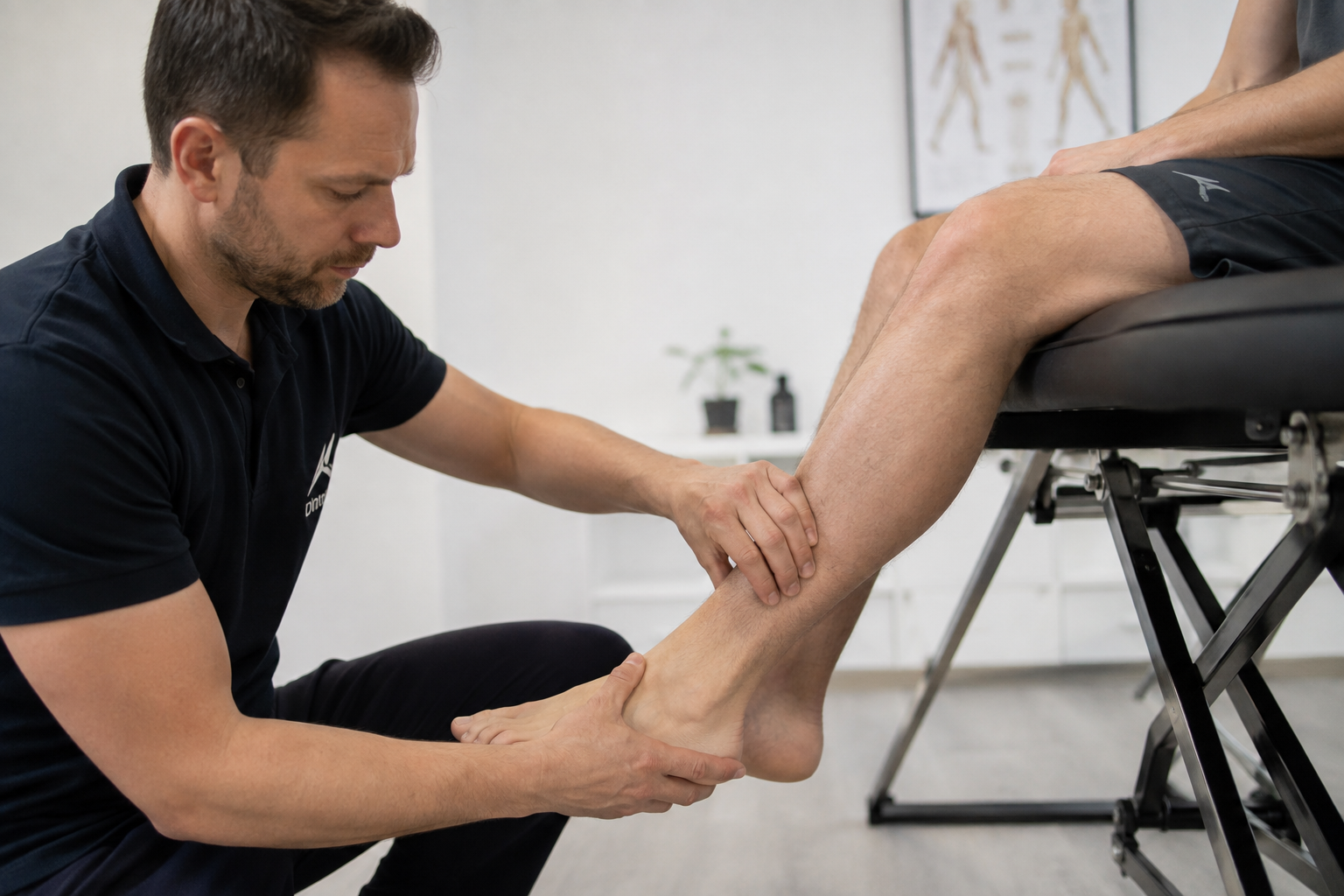
At USC Fysiotherapie in Amsterdam East, we look beyond just pain and swelling. We first assess whether additional diagnostics are needed, for example to rule out a fracture, and then map out the ankle's range of motion and swelling. If there is doubt about the severity of the ligament injury, an ultrasound can optionally be performed, allowing us to see immediately if and to what extent the ligaments are damaged. This provides extra clarity for the right treatment plan. We then test your strength and stability and begin targeted exercises for balance and coordination. Step by step, we work together to rebuild walking, jumping, and sport-specific movements, while also advising on the use of a brace or tape if relevant. At the end of the process, we objectively test whether you are ready to return to sports.
This is important, because an incompletely recovered ankle is more likely to be sprained again. With targeted sports physical therapy, balance training, and progressive loading, we guide you step by step back to full capacity—utilizing our spacious fitness areas and exercise rooms on-site. This way, you can move and play sports with confidence again.
Frequently asked questions
Can I walk with a sprained ankle?
With a mild sprain, you can often continue to walk carefully, provided it does not cause too much pain. In the case of severe pain or if you can barely put weight on it, it is wise to rest first and have the ankle assessed.
Is it good to ice a sprained ankle?
Cooling may provide temporary relief, but there is no strong evidence that it accelerates healing. It is not a mandatory part of the treatment.
How long does an ankle stay swollen after a sprain?
Swelling can decrease significantly after a few days to a week for a mild sprain, but slight residual swelling can persist for weeks with more severe injuries.
When can I start exercising again?
This varies per person and the severity of the injury. More important than a fixed timeframe is whether your ankle is pain-free, stable, strong, and mobile enough for sport-specific movements.
Why does my ankle remain unstable?
This is often because the ligaments and balance (proprioception) have not yet fully recovered, even if the pain is gone. Targeted balance and stability training is important in that case.
Can a sprained ankle heal on its own?
A mild sprain often heals on its own. In the case of persistent complaints, repeated sprains, or a feeling of instability, it is wise to consult a physiotherapist to prevent a chronically unstable ankle.
Have you been dealing with an unstable ankle for a while, or are you afraid to return to sports after a sprain? Don't wait too long and make an appointment at USC Fysiotherapie. With locations at Science Park, Amstelcampus, and Roeterseiland in Amsterdam East, we are easily accessible. Together, we will ensure a solid, lasting foundation for your ankle.