What is a muscle tear?

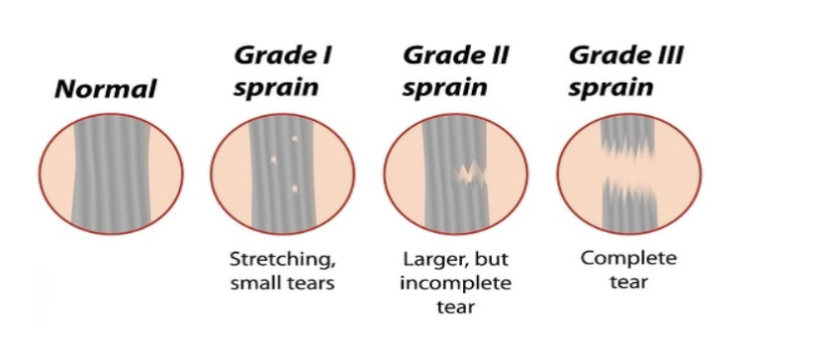
The most commonly affected muscles are the hamstrings, quadriceps, and calf muscle, partly because these muscles span multiple joints and are therefore subjected to greater stress during sports. The extent of a muscle tear can be divided into three categories, depending on the severity of the damage to the muscle fibers.
Grade 1
- Strain with only a few muscle fibers stretched, minimal tearing (less than 10 percent).
- No palpable defect in the muscle.
- Often pain-free after a few days during ADL tasks (walking, cycling, etc.).
Grade 2
- Strain where the muscle fibers are partially torn (between 10 and 50 percent).
- Usually, there is a palpable tear in the muscle.
- Limitation in ADL tasks for several days or weeks.
Grade 3
- Strain with an extensive or total tear (50 to 100 percent) of the muscle fibers.
- Clear, easily palpable tear in the muscle belly.
- Normal muscle function is virtually impossible.
What are the symptoms?
A muscle tear is characterized by various symptoms, including:
- Sudden onset of localized pain with a cramping sensation.
- Pain during passive stretching or contraction of the affected muscle.
- Possible swollen muscle belly above or below the injury with potential bruising.
- Prolonged stiffness at the affected site.
- With a grade 2 or 3 tear, there may be loss of function of the affected body part, for example, difficulty bending the knee with a hamstring injury.
How does recovery proceed?
1. Inflammatory phase: Heat, redness, swelling, and pain are characteristic. Restricted movement may occur.
The recent tear still feels sensitive to the touch and remains slightly palpable during daily activities. Stiffness in the area and quicker muscle fatigue are noticeable. You are often still very preoccupied with it and find it daunting to load it.
2. Proliferative phase: Fibroblasts produce collagen fibers, new connective tissue formation occurs, and the wound becomes stronger.
You can do more again. During daily tasks, you no longer feel the tear, and you dare to gradually add more load. The new fibers are not yet as strong as before, so this is the right time to do light exercises independently or under supervision, which strengthens the new fibers and prepares them for the next phase.
3. Remodeling phase: The tensile strength of the wound increases, and the connective tissue begins to resemble the original tissue.
You can do more and more, and for most of the day, you don't have to think about the tear. Occasionally you are reminded of it, for example, when you speed up to catch the bus. It is now crucial not to return to sports activities too quickly and to build up recovery slowly to give the new fibers time to strengthen. A program focused on strength and muscle control is recommended, after which you can gradually introduce more explosive movements.
A controlled build-up of function takes time, and the exercise program varies per person and per muscle injury. It can therefore be helpful to resume sports activities under the guidance of a physical therapist to prevent recurrence and further injuries.
In rare cases, the rupture is so large that additional diagnostics such as an ultrasound or MRI are needed to get a clear picture; however, this does not happen often.
How can we help you?
A physical therapist can play a valuable role in the recovery process after a muscle tear. Our treatment often includes an exercise program to strengthen the muscles and build up to full load. The treatment depends on the severity of the muscle tear and includes attention to muscle weakness, balance, and return to play. Additionally, based on experience, an estimate can be made regarding the time you should refrain from sports or participate in modified activities.
It is important to build up properly because re-tearing of the fibers often occurs due to suboptimal progression.
Brumitt, J., & Cuddeford, T. (2015). Current concepts of muscle and tendon adaptation to strength and conditioning. International journal of sports physical therapy, 10(6), 748.
Garrett Jr, W. E. (1996). Muscle strain injuries. The American journal of sports medicine, 24(6_suppl), S2-S8.
Khan, K., & Brukner, P. (2011). Clinical sports medicine. McGraw-Hill Medical.
Pollock, N., James, S. L., Lee, J. C., & Chakraverty, R. (2014). British athletics muscle injury classification: a new grading system. British journal of sports medicine.