Runeasi for an Achilles tendon injury

How Runeasi Supported Thomas's Achilles Tendon Recovery
Background: Thomas is a driven runner who trains with the fastest running group at his athletics club and works with a personal marathon coach. He has had Achilles tendon issues in the past, but in late May 2023, he sustained an injury to his left Achilles tendon during a 5 km race on the track. Despite improving his personal best by 27 seconds and completing the distance in 15:38 minutes, the injury caused severe post-race pain, making it impossible for him to even stand on his foot in the following days. After ten days of rest, he tried running again, but the pain returned after just 3 minutes, whether he wore his super shoes or regular shoes.
Seeking a sustainable solution, Thomas came to our clinic.
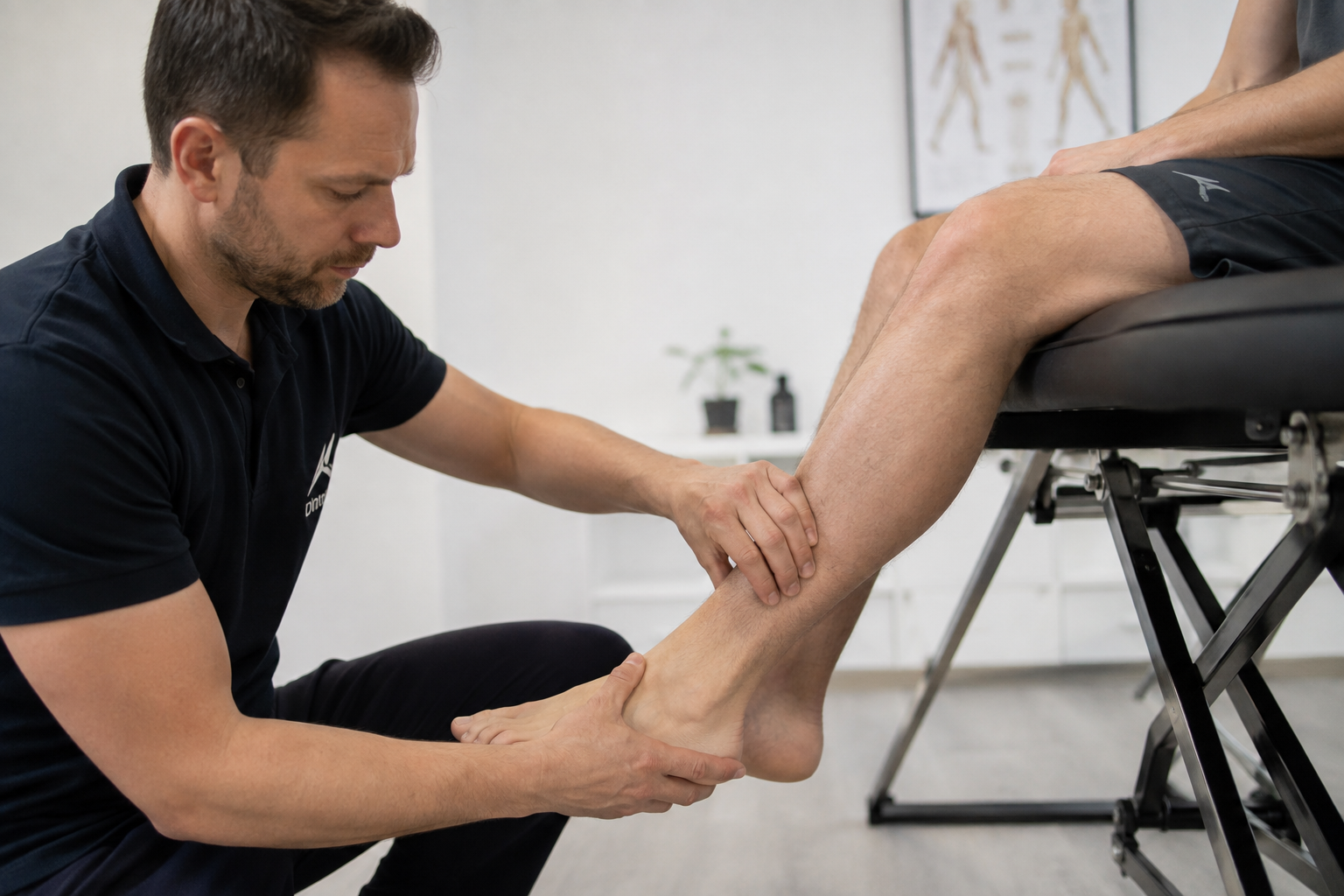
We combined: physical examination, ultrasound, slow-motion running analysis, and Runeasi tests.
Further physical examination revealed a weak link in the kinetic chain in his lower back and limited hip extension, which negatively affected his running posture. An ultrasound showed that his left Achilles tendon was thickened to 9.2 mm, compared to 5.4 mm on the right side. Furthermore, when running, he landed heavily on the outer edge of his left forefoot, far in front of his center of gravity, leading to uncontrolled pronation. His deep calf muscle on the left was also weakened.
These findings were supplemented by Runeasi tests at various speeds and with different shoes.
A low speed of 6 min/km in his endurance running shoes yielded the best results, but with a Running Quality score of 41%, it was still very low. Notably, Runeasi indicated that his right leg was less stable (red arrow), while impact forces were higher on his left leg (orange arrow) and ground contact on the left was too long (blue arrow), indicating significant asymmetry.

Our recovery plan for Thomas focused on:
- Improving joint mobility, stability, and strengthening the tendon.
- Refining running technique to optimize symmetry. This involved correcting his running style from a "backseat runner" to a slightly forward-leaning posture with a stable lower back.
- Build-up schedule, first mileage, then speed.
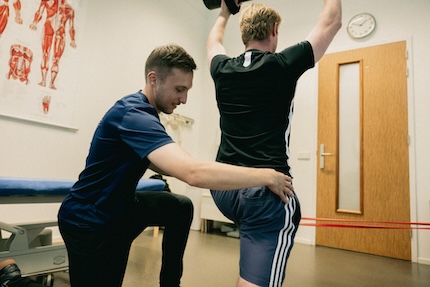
To improve this, we started with simple exercises and heavy slow resistance strength exercises to strengthen the tendons. Although the execution was initially difficult, Thomas proved motivated to work on it, despite knowing it would take time. He also noticed that these exercises made it easier for him to improve his running posture while running.
Adjusting running technique and building up mileage: Because he was open to running technique adjustments, we worked on optimizing his stride frequency and ground contact time within his build-up schedule. Additionally, he gradually increased his running workouts, with special attention to left-right load symmetry. Soon he was able to run 60 km per week again, although faster paces still provoked Achilles symptoms. His fitness improved, but building tendon quality for higher speeds proved to require time.
A month later, the new Runeasi test at 6 min/km showed clear improvements. However, further analysis at higher speeds, such as 3:30 min/km, showed low scores for stability and symmetry, especially in his right leg. Because the Achilles tendon reacted to these faster paces, we convinced him, based on the Runeasi score and post-exercise pain, to avoid these speeds, so that the tendon would have time to strengthen.
Progress and new insights: In the following weeks, he left for a two-week training camp in the Kenyan highlands to increase his mileage and slightly raise his speed, but at speeds above 3:40 min/km, there was still a slight reaction. Back in the Netherlands, his Achilles tendon still showed a slight thickening of 7 mm on the ultrasound. Following this, he received new running coordination exercises focused on right foot placement, which proved to be well executable this time. A new Runeasi test showed that this directly reduced ground contact time and impact on the left.
The test results were promising: fewer complaints, higher speed, and a greater weekly volume.

By September 2024, he was able to train at speed again, without any tendon reaction.
Thomas's experience with Runeasi: Thomas described Runeasi as a valuable tool for adjusting his running load. "By looking at the optimal speed and cadence, I could train with less post-exercise pain and morning stiffness," he says. Runeasi helped him gain real-time insight into the impact of foot placement corrections, which motivated him to continue working on his posture.
"Apparently, I was landing with my right foot strongly externally rotated and far in front of my body. Correcting it took a lot of time and effort, but it immediately felt better and reduced my Achilles tendon symptoms. I have also corrected my backseat-running posture, which has made me a better runner. Thanks to exercises tailored to me, I can now follow a full training schedule again."